

 简体中文
简体中文 English
TEL:4006258268
FAX:020-36657099
E-mail:service@gzhw.com
Info E-mail: grand.tt@grandeurhw.com
Address: 18th Floor, Global Trade Center, No. 148 Xingang East Road, Haizhu District, Guangzhou, China
Industry Information
Location:Home > News > Industry Information > DetailAnalysis of the Development Status of China's Leather Industry in 2020: Significant Increase in Downward Industry Pressure
Date:2026-02-25 11:02:06
Source: Qianzhan Industry Research Institute
Overview of the Development of China's Leather Industry
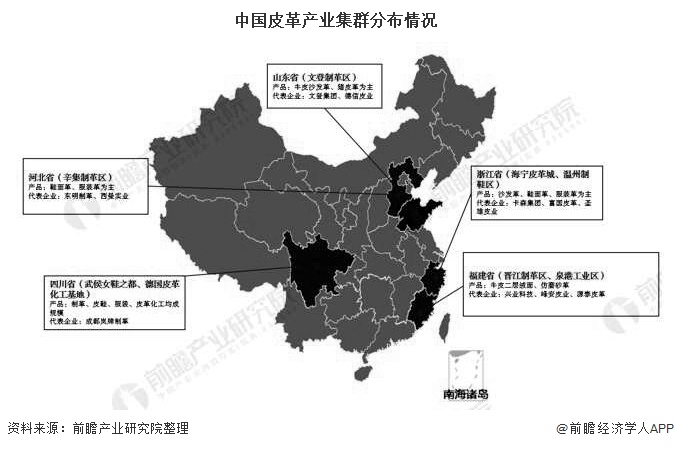
In 2019, the global economic growth rate continued to decline, the growth of international trade and investment performed poorly, and the external environment for the development of the leather industry was extremely severe. In terms of domestic production, the output of above-scale light leather in China reached 574 million square meters in 2019, and leather industry clusters were mainly distributed in Fujian, Sichuan, Hebei, Guangdong, Shandong, Zhejiang and other regions.
In terms of the leather price index, the overall leather price has shown a downward trend in recent years, with the index remaining below 100 points and standing at 75.43 points by the end of August 2020.
In terms of industry operation, the industry's sales revenue declined, reaching 1,098.199 billion yuan in 2019.
Overall, the downward pressure on the economic operation of the industry has increased significantly. It is an urgent task to accelerate high-quality development, maintain the healthy and sustainable development of the industry, and enhance its risk resistance capacity.
1. China's Leather Output Nears 600 Million Square Meters, Mainly Concentrated in Hebei, Fujian, Sichuan, Shandong and Other Regions
In terms of production, the output of above-scale light leather in China was 574 million square meters in 2019, with Hebei Province accounting for the largest share at a staggering 33.6%. Among the downstream products industry, the output of above-scale fur garment enterprises rose, the output of above-scale leather footwear enterprises saw a slight increase, while the output of leather garments declined.
In 2019, the output of above-scale fur garment enterprises in China reached 4.777 million pieces, a year-on-year increase of 22.82%; the output of above-scale leather shoes enterprises hit 3.947 billion pairs, a year-on-year increase of 1.79%; the output of above-scale leather garment enterprises stood at 65.6623 million pieces, a year-on-year decrease of 9.22%.
Statistics of China's Leather Output from 2015 to the First 9 Months of 2020
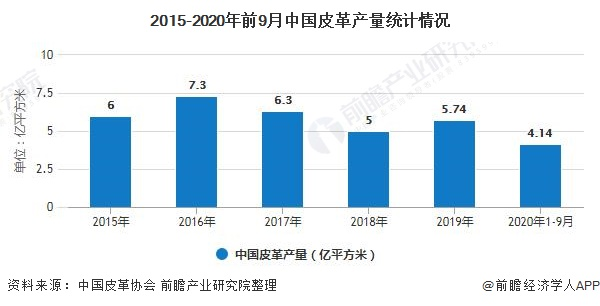
In terms of industrial regional distribution, China's leather output is mainly concentrated in Fujian, Sichuan, Hebei, Guangdong, Shandong, Zhejiang and other regions. In recent years, China's tanning enterprises have gradually shifted from large and medium-sized cities to small cities and towns. 70% of the enterprises are concentrated in coastal areas such as Fujian, Zhejiang and Guangdong provinces, yet most of them are small-sized enterprises, with a small number of large-scale enterprises and a low degree of production concentration.
Through structural adjustment and optimization, China's leather industry clusters have developed rapidly, and initially formed industrial cluster areas with well-matched upstream, midstream and downstream products, strong specialization, clear division of labor, distinct characteristics and a pivotal role in driving the local economy. In terms of spatial layout, the eastern, central and western regions have developed in a coordinated manner, promoting the orderly and professional transfer and effective undertaking of the industry. Relying on their advantages in labor force and raw hide resources, Sichuan, Hebei, Shandong and other regions have undertaken the gradient industrial transfer, achieved new leaps on new technologies and platforms, and taken a new path of industrialization development that combines transfer and transformation, and advances with upgrading and expansion.
Distribution of China's Leather Industry Clusters
2. China's Overall Leather Price on the Decline with the Index Below 100 Points
In terms of the leather price index, the overall leather price witnessed a downward trend from 2015 to August 2020. At the beginning of 2015, the price index stood at 114.96 points and hit a recent peak of 119.35 points by the end of February 2015. After 2018, the price index dropped below 100 points, with a slight fluctuating recovery in the second half of 2019 but still remaining below 100. By the end of August 2020, the leather price index was 75.43 points.
3. Declining Sales Revenue of China's Leather Industry, with the Industry Under Pressure Amid Stability
Overall, the sales revenue of the above-scale leather industry saw a fluctuating decline from 2015 to 2019. In 2019, China's above-scale core leather industry (footwear manufacturing, bag and luggage making, leather tanning, leather garment production, fur and fur products) achieved sales revenue of 1,098.199 billion yuan, a year-on-year decrease of 0.87%, with the annual performance characterized by a high start and a low finish.
Statistics of Sales Revenue of China's Above-Scale Leather Industry from 2015 to 2019
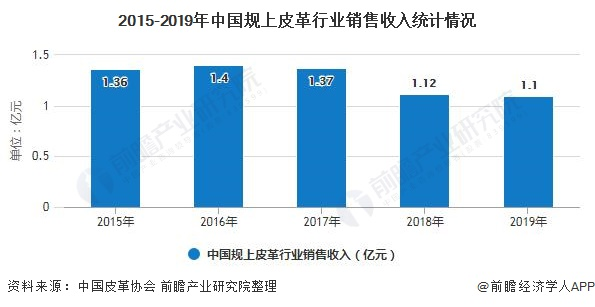
In 2019, among the above-scale core leather industry, the sales revenue of above-scale footwear enterprises reached 681.832 billion yuan, a year-on-year increase of 2.05%; that of above-scale bag and luggage enterprises stood at 141.905 billion yuan, a year-on-year decrease of 1.66%; that of above-scale tanning enterprises hit 118.263 billion yuan, a year-on-year decrease of 13.14%; that of above-scale leather garment enterprises reached 58.511 billion yuan, a year-on-year increase of 6.43%; and that of above-scale fur and fur products enterprises was 53.601 billion yuan, a year-on-year increase of 1.55%. The total profit of the above-scale core leather industry was 65.837 billion yuan, a year-on-year decrease of 1.96%.
Distribution of Sales Revenue of China's Above-Scale Core Leather Industry in 2019
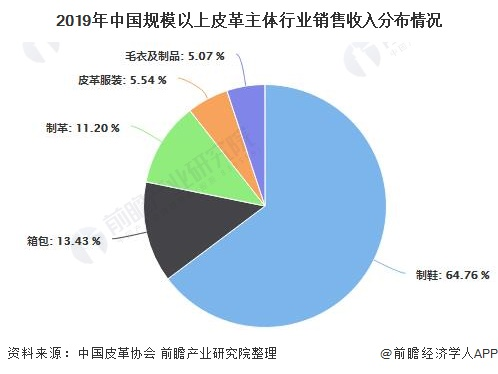
On the whole, although the industry operation remained generally stable, with the sales revenue of above-scale footwear, leather garment, fur and fur products enterprises registering a slight year-on-year increase, both the sales revenue and total profit of the industry's above-scale enterprises declined. The sales revenue of above-scale enterprises in sub-sectors such as bag and luggage making and leather tanning dropped, with the leather tanning industry seeing a particularly obvious decline. The downward pressure on the industry has increased significantly.